Quickstart: round-trip a golden ECG codec
Open in Colab opens the source notebook only. Before running cells, use a Python 3.12 runtime and install compressionKIT into that runtime. See notebook environment setup. Hosted execution has not been validated by this documentation build.
This example displays saved outputs. Building the documentation does not run training. Check dataset paths for your notebook working directory before running.
Load a published compressionKIT golden ECG codec, compress and decompress a physiological frame, and measure the true compression ratio and fidelity.
No dataset required. Every deploy package ships a small set of
representative, license-safe reference frames (reference_vectors.npz) that we
use here, so the notebook runs anywhere.
Loading from HuggingFace needs internet access. To run fully offline, point
CODEC_SOURCEat a local deploy package you built withcompressionkit golden run ....
from pathlib import Path
import matplotlib.pyplot as pltimport numpy as np
from compressionkit.evaluation.metrics import compute_signal_metricsfrom compressionkit.runtime import load_codec, resolve_deploy_dir
# A published golden codec (downloads from HuggingFace) ...# "-v1.0" repos are the current release track. Uncomment any line below to# try a different compression ratio or codec family (RVQ = learned/AI, SPIHT =# DSP-only wavelet codec, hybrid = learned denoiser + SPIHT). All three families# implement the same Codec interface, so nothing below this cell needs to change.CODEC_SOURCE = "Ambiq/compressionkit-ecg-8x-v1.0"# CODEC_SOURCE = "Ambiq/compressionkit-ecg-2x-v1.0"# CODEC_SOURCE = "Ambiq/compressionkit-ecg-4x-v1.0"# CODEC_SOURCE = "Ambiq/compressionkit-ecg-16x-v1.0"# CODEC_SOURCE = "Ambiq/compressionkit-ecg-32x-v1.0"# CODEC_SOURCE = "Ambiq/compressionkit-ecg-64x-v1.0"# SPIHT (DSP-only, no trained weights) and hybrid (learned denoiser + SPIHT):# CODEC_SOURCE = "Ambiq/compressionkit-ecg-spiht-8x-v1.0"# CODEC_SOURCE = "Ambiq/compressionkit-ecg-hybrid-8x-v1.0"# ... or a local deploy package you built yourself:# CODEC_SOURCE = "results/ecg_rvq_256hz_04x_golden/deploy"2026-07-02 01:19:05.830539: I tensorflow/core/util/port.cc:153] oneDNN custom operations are on. You may see slightly different numerical results due to floating-point round-off errors from different computation orders. To turn them off, set the environment variable `TF_ENABLE_ONEDNN_OPTS=0`.2026-07-02 01:19:05.854934: I tensorflow/core/platform/cpu_feature_guard.cc:210] This TensorFlow binary is optimized to use available CPU instructions in performance-critical operations.To enable the following instructions: AVX2 AVX_VNNI FMA, in other operations, rebuild TensorFlow with the appropriate compiler flags.2026-07-02 01:19:06.397691: I tensorflow/core/util/port.cc:153] oneDNN custom operations are on. You may see slightly different numerical results due to floating-point round-off errors from different computation orders. To turn them off, set the environment variable `TF_ENABLE_ONEDNN_OPTS=0`.codec = load_codec(CODEC_SOURCE)
print(f"name : {codec.name}")print(f"modality : {codec.modality}")print(f"sample_rate : {codec.sample_rate} Hz")print(f"frame_size : {codec.frame_size} samples ({codec.frame_size / codec.sample_rate:.2f} s)")print(f"target CR : {codec.target_cr:g}x")Fetching 15 files: 100%|██████████| 15/15 [00:00<00:00, 76445.39it/s]name : ecg_rvq_256hz_08x_golden_empirical_midpointmodality : ecgsample_rate : 256 Hzframe_size : 512 samples (2.00 s)target CR : 8xINFO: Created TensorFlow Lite XNNPACK delegate for CPU.Representative frames
Section titled “Representative frames”Release packages include license-safe frames for smoke tests and demos. When
reference_vectors.npz is present, the notebook uses its exact runtime
conformance inputs. Otherwise it falls back to sample_stimulus.npz or
sample_data.npz from the deploy package.
deploy = Path(resolve_deploy_dir(CODEC_SOURCE))
sample_candidates = [    ("reference_vectors.npz", ("input_frames", "inputs", "stimulus")),    ("sample_stimulus.npz", ("input_frames", "inputs", "stimulus")),    ("sample_data.npz", ("input_frames", "inputs", "stimulus")),]
for filename, keys in sample_candidates:    sample_path = deploy / filename    if not sample_path.exists():        continue    sample_npz = np.load(sample_path)    for key in keys:        if key in sample_npz:            sample_source = f"{filename}:{key}"            raw_frames = sample_npz[key]            break    else:        continue    breakelse:    raise FileNotFoundError(        f"No sample frame artifact found in {deploy}. Expected one of: "        + ", ".join(name for name, _ in sample_candidates)    )
raw_frames = np.asarray(raw_frames, dtype="float32")if raw_frames.ndim == 1:    frames = raw_frames.reshape(1, -1)elif raw_frames.ndim == 2:    frames = raw_frameselse:    frames = raw_frames.reshape(raw_frames.shape[0], -1)
if frames.shape[1] != codec.frame_size:    raise ValueError(        f"Sample frames from {sample_source} have {frames.shape[1]} samples, "        f"but codec.frame_size is {codec.frame_size}."    )
print(f"Loaded {len(frames)} sample frames from {sample_source}")Fetching 15 files: 100%|██████████| 15/15 [00:00<00:00, 34817.13it/s]Loaded 500 sample frames from sample_stimulus.npz:inputsRound-trip a single frame
Section titled “Round-trip a single frame”Compression ratio is reported against a 32-bit float sample baseline — the
toolkit’s reference raw representation, which matches the headline target CR.
frame = frames[0]encoded = codec.compress(frame)recon = codec.decompress(encoded)
raw_bits = frame.size * 32  # 32-bit float baselinetrue_cr = raw_bits / encoded.nbitsm = compute_signal_metrics(frame, recon)
print(f"encoded bits : {encoded.nbits} -> measured CR {true_cr:.2f}x (vs 32-bit float)")print(f"PRD : {m['prd_percent']:.2f}%")print(f"cosine sim : {m['cosine_similarity']:.4f}")encoded bits : 2048 -> measured CR 8.00x (vs 32-bit float)PRD : 6.65%cosine sim : 0.9978t = np.arange(frame.size) / codec.sample_rateplt.figure(figsize=(10, 3))plt.plot(t, frame, label="original", lw=1.5)plt.plot(t, recon, label="reconstruction", lw=1.2, alpha=0.85)plt.xlabel("time (s)")plt.ylabel("amplitude")plt.title(f"{codec.name} · PRD {m['prd_percent']:.2f}% · CR {true_cr:.2f}x")plt.legend()plt.tight_layout()plt.show()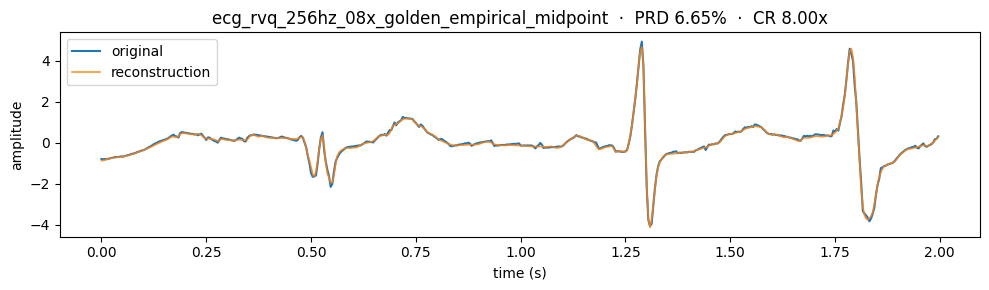
Aggregate over many frames
Section titled “Aggregate over many frames”A single number hides the spread. Round-trip a batch and look at the distribution of fidelity alongside the realized compression ratio.
N = min(500, len(frames))batch = frames[:N]
total_bits = 0prd, cos = [], []for f in batch:    e = codec.compress(f)    r = codec.decompress(e)    total_bits += e.nbits    mm = compute_signal_metrics(f, r)    prd.append(mm["prd_percent"])    cos.append(mm["cosine_similarity"])
prd = np.asarray(prd)cos = np.asarray(cos)print(f"frames evaluated : {N}")print(f"measured CR : {(batch.size * 32) / total_bits:.2f}x")print(f"PRD % : median {np.median(prd):.2f} mean {prd.mean():.2f}")print(f"cosine : median {np.median(cos):.4f} mean {cos.mean():.4f}")frames evaluated : 500measured CR : 8.00xPRD % : median 6.37 mean 7.06cosine : median 0.9980 mean 0.9970plt.figure(figsize=(10, 3))plt.hist(prd, bins=30, color="#4C78A8")plt.axvline(np.median(prd), color="k", ls="--", label=f"median {np.median(prd):.2f}%")plt.xlabel("PRD %")plt.ylabel("frames")plt.title("Per-frame fidelity distribution")plt.legend()plt.tight_layout()plt.show()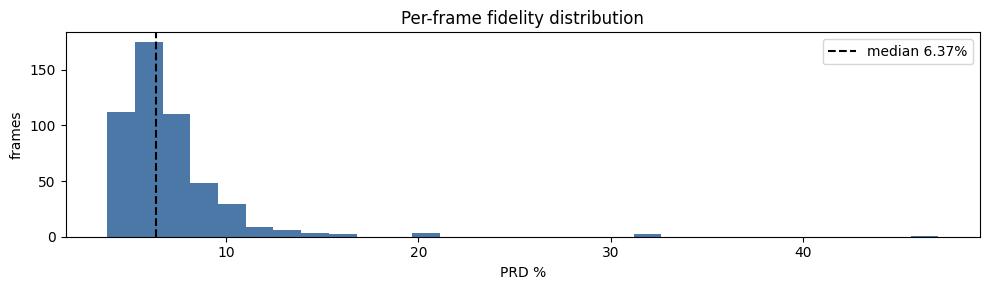
Next steps
Section titled “Next steps”- Swap
CODEC_SOURCEfor any tier in the Model Zoo as more ECG CRs are published under the-v1.0track. - Try the PPG version:
01_quickstart_golden_codec.ipynb. - Evaluate on your own recordings — see
02_evaluate_on_your_data.ipynb. - Reproduce a golden end-to-end:
compressionkit golden run ecg-rvq-4x.