PPG Models (v1.1 exports)
PPG release artifacts and comparison lanes at 64 Hz. The published HuggingFace bundles are RVQ neural codecs; the experiment registry also includes SPIHT DSP and hybrid AI+DSP configurations with package links.
Historical RVQ results
Section titled “Historical RVQ results”The v1.1 bundles correct the exports of existing checkpoints without retraining. The tables below are historical physiological evaluations, not new measurements of the corrected deployment bundles. See release details for measured export parity and packet sizes.
These validation results and the noise-aware customer scorecards use different evaluation views. Keep the metric definitions and recording windows with the numbers when comparing results.
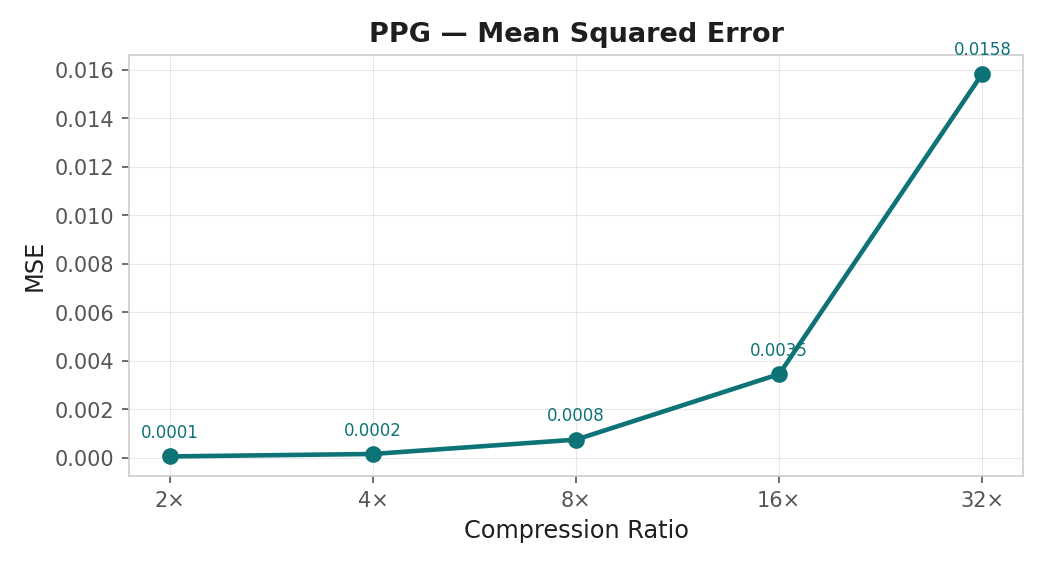
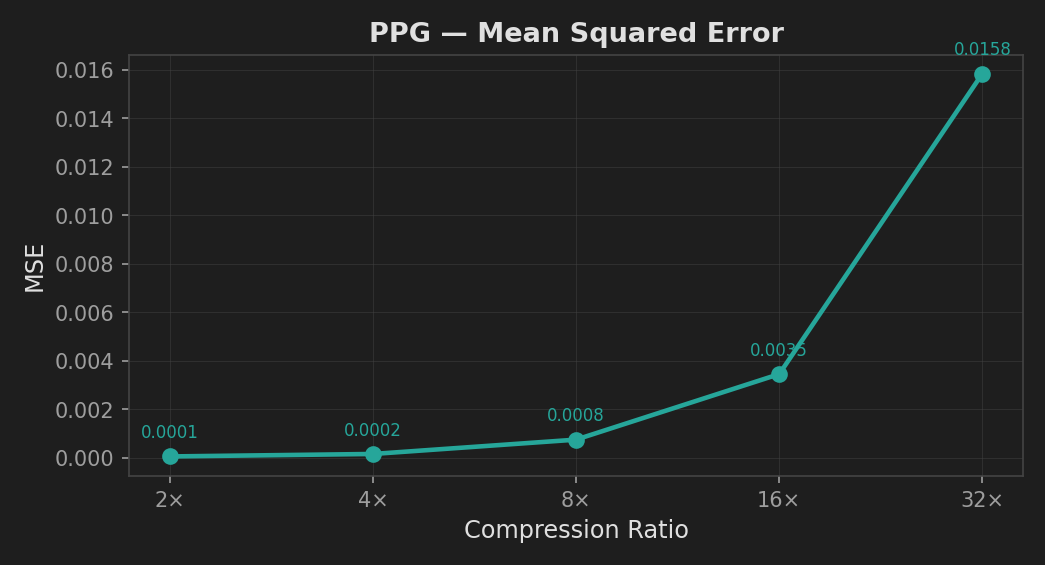
| Model | Config | CR | PRD (%) | MSE | Cosine |
|---|---|---|---|---|---|
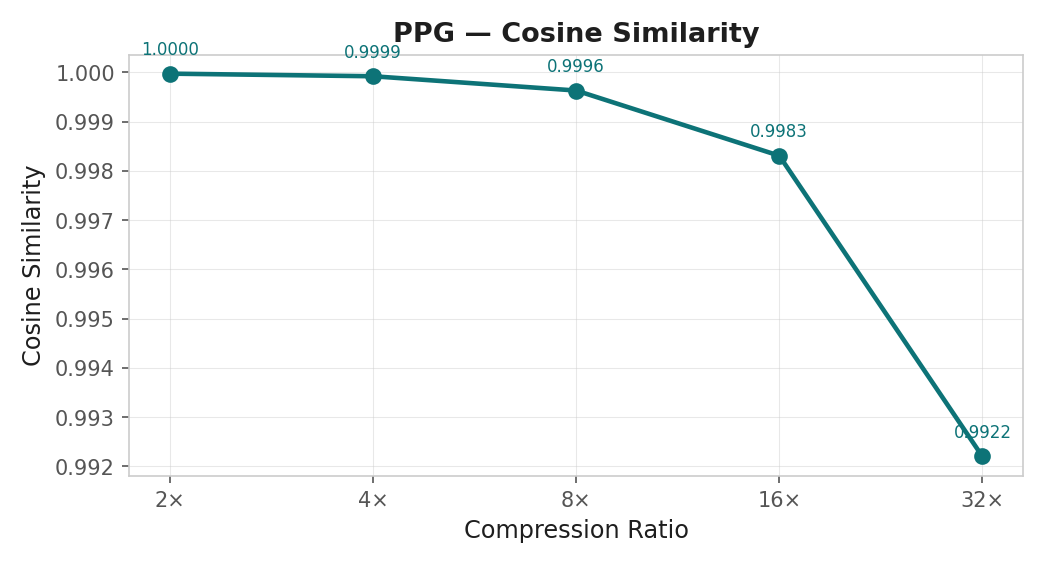
ppg-rvq-02x | ppg_rvq_64hz_02x_golden.yaml | 2.00x | 0.80 | 0.000063 | 0.99997 |
ppg-rvq-04x | ppg_rvq_64hz_04x_golden.yaml | 4.00x | 1.29 | 0.000165 | 0.99992 |
ppg-rvq-08x | ppg_rvq_64hz_08x_golden.yaml | 8.00x | 2.76 | 0.000756 | 0.99963 |
ppg-rvq-16x | ppg_rvq_64hz_16x_golden.yaml | 16.00x | 5.90 | 0.003457 | 0.99831 |
ppg-rvq-32x | ppg_rvq_64hz_32x_golden.yaml | 32.00x | 12.62 | 0.015843 | 0.99220 |
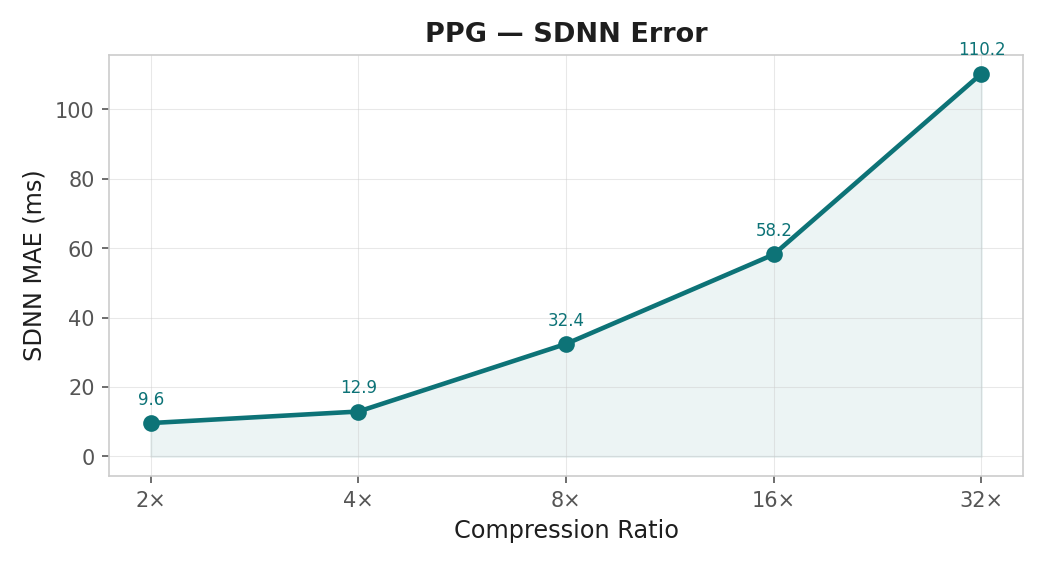
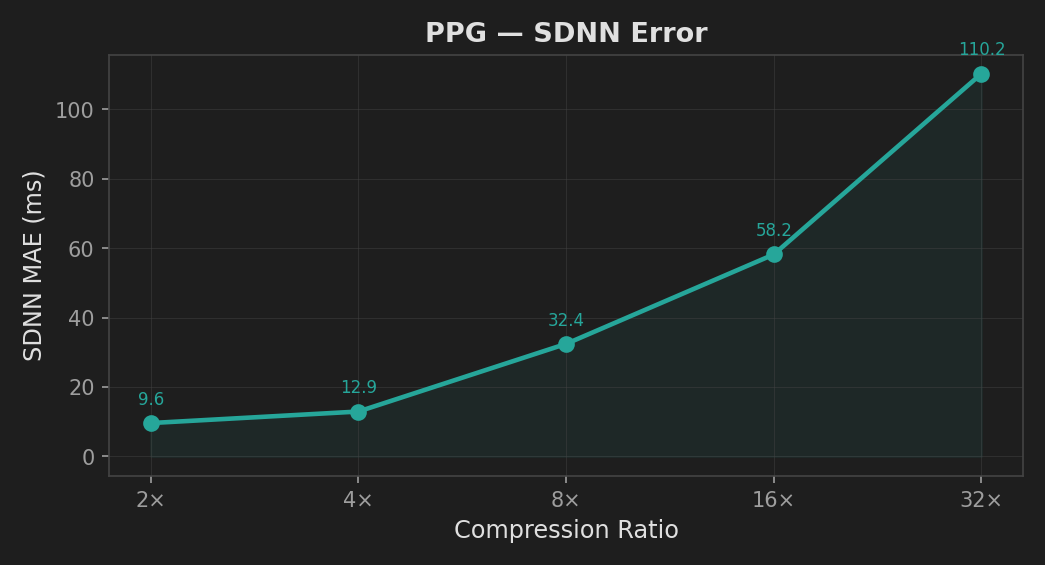
| Model | HR MAE (bpm) | SDNN MAE (ms) |
|---|---|---|
ppg-rvq-02x | 0.06 | 9.6 |
ppg-rvq-04x | 0.05 | 12.9 |
ppg-rvq-08x | 0.10 | 32.4 |
ppg-rvq-16x | 0.19 | 58.2 |
ppg-rvq-32x | 0.36 | 110.2 |
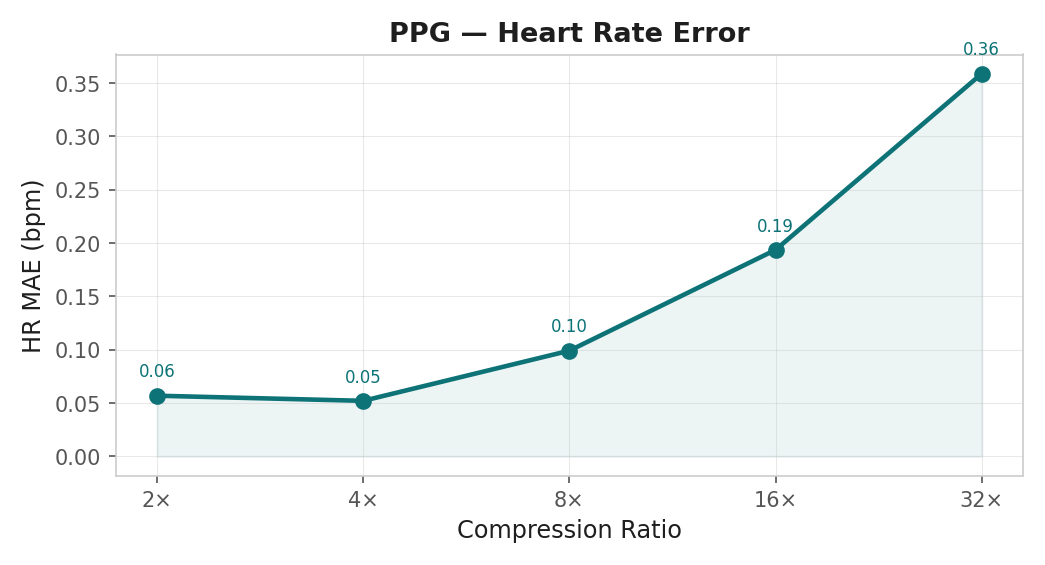
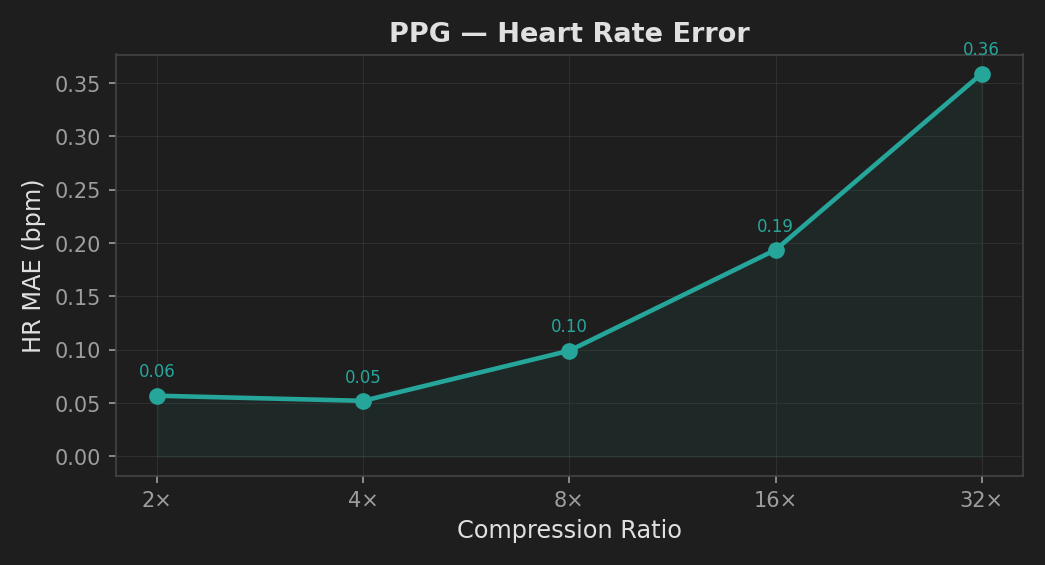
All metrics are on the validation set. HR/HRV metrics are from long-recording overlap-add evaluation (60 s windows, 50% hop).
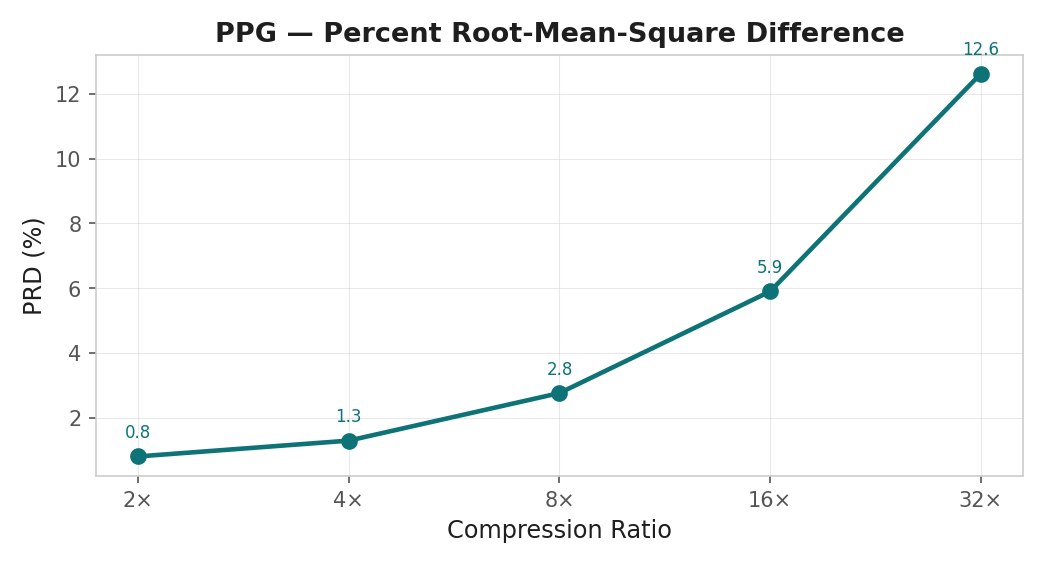
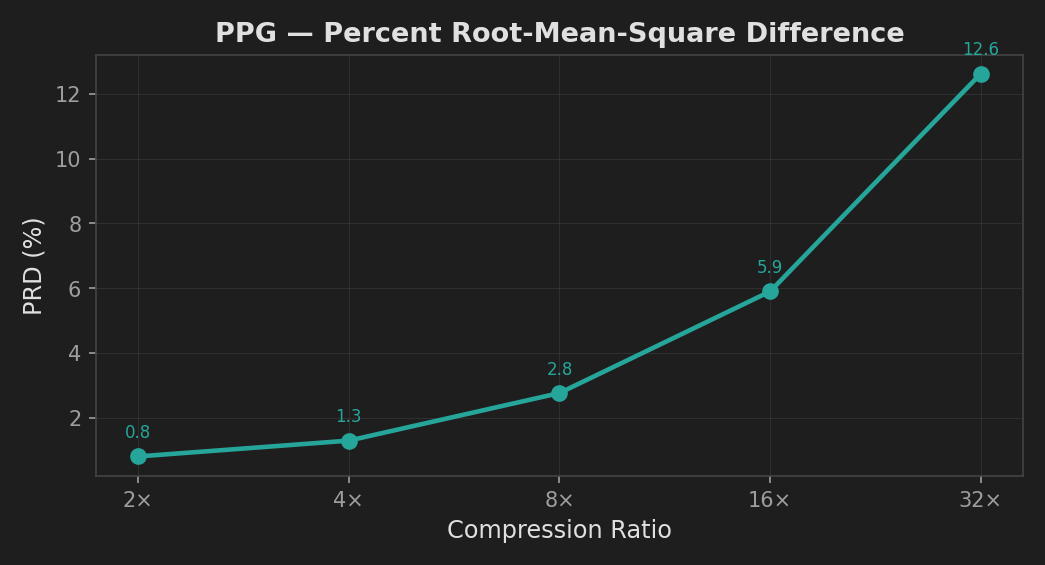
Mean squared error plots
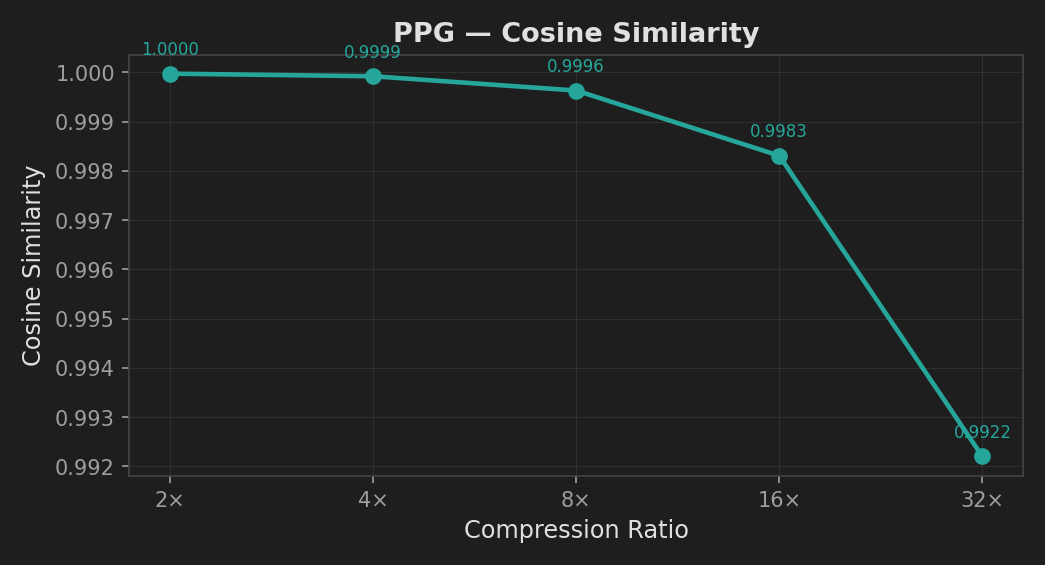
Cosine similarity plots
Codec tradeoffs under noise and artifacts
Section titled “Codec tradeoffs under noise and artifacts”PPG has three release-facing comparison lanes:
| Lane | Role | Current publication status |
|---|---|---|
| SPIHT | DSP faithfulness baseline; preserves clean/noisy inputs with minimal learned behavior | Hugging Face package links on the experiment pages |
| RVQ | Published neural codec bundles; compact learned representation with physiological scorecards | Published for 2x, 4x, 8x, 16x, and 32x |
| Hybrid | Learned denoising front end with a SPIHT backend; designed for wearable-noise regimes | Hugging Face package links on the experiment pages |
The robustness sweep scores each lane against a filtered clean-truth proxy after injecting empirical noise or additive artifacts. Lower PRD is better. This is a different question from faithful reconstruction of a clean validation frame: it asks which codec best preserves the recoverable pulse waveform when the input is already corrupted.
| Condition family | Current PPG crossover pattern |
|---|---|
| Clean input | SPIHT wins at 2x-8x, while RVQ wins at 16x-32x in the current robustness fixture. |
| Native / empirical SNR ladder | Hybrid wins most injected-noise cells from native through -12 dB. At 32x, RVQ remains strongest for native, 12 dB, and 8 dB before hybrid takes over at heavier noise. |
| Motion artifacts | RVQ is the current winner across the measured CR ladder. |
| Baseline wander | Hybrid is the current winner across the measured CR ladder. |
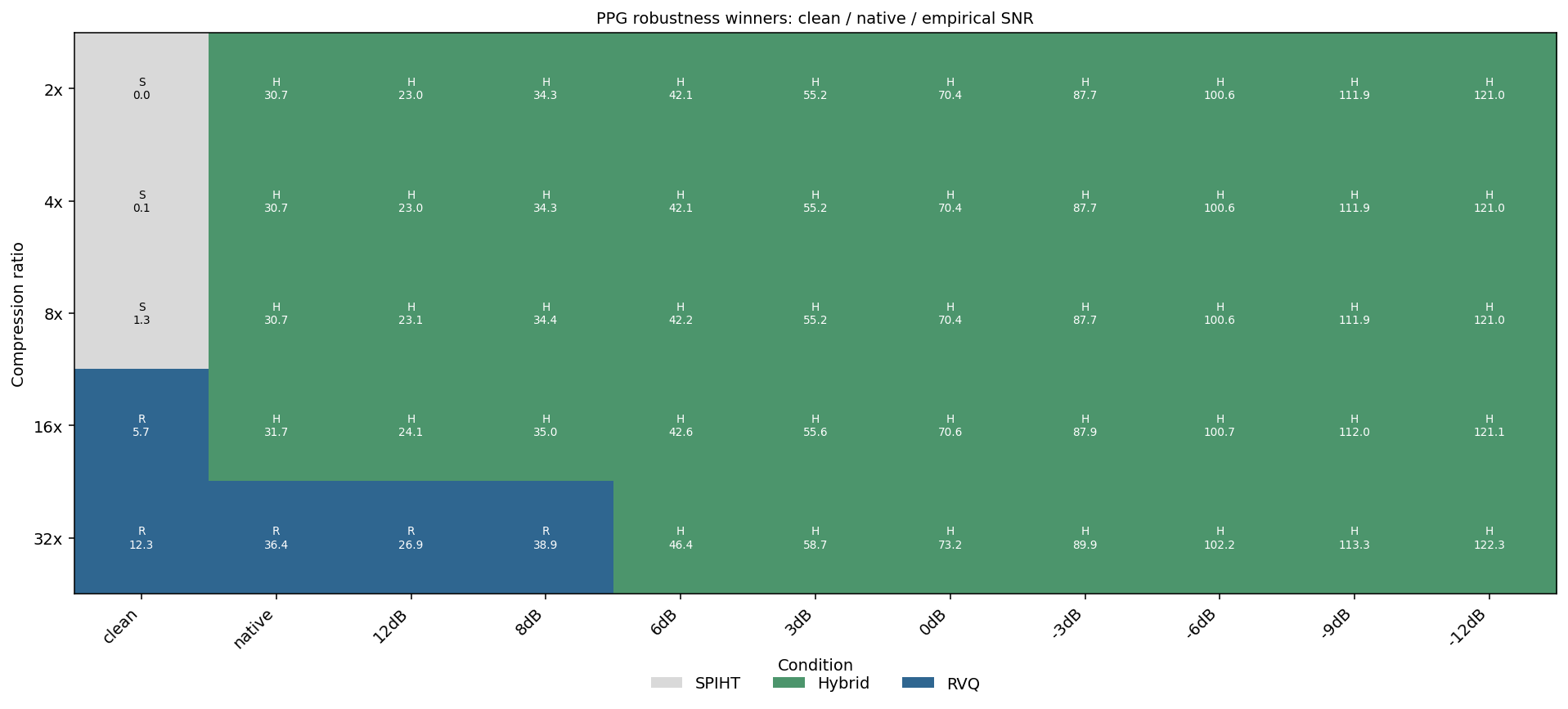
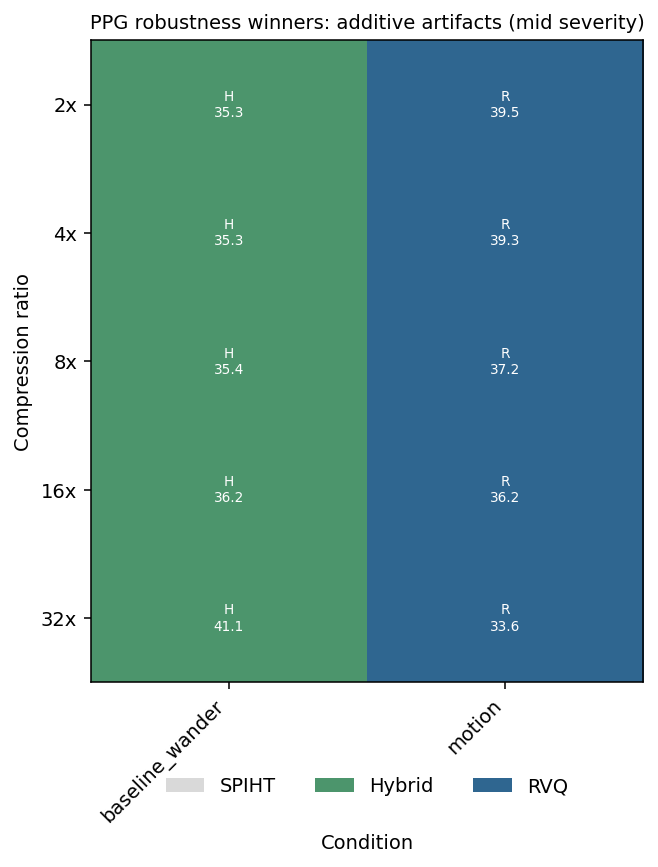
The practical read is that SPIHT is a strong low-noise baseline, RVQ is the published neural operating surface, and hybrid approaches become important when the input looks more like a wrist-worn signal with empirical noise or drift. See PPG CR vs fidelity and Validation Scorecard for the detailed scorecard definitions and noise-aware metrics.
Model Details
Section titled “Model Details”Architecture
Section titled “Architecture”All PPG models share the same architecture:
- Encoder: Strided Conv2D blocks (stride 2 per stage) with depthwise-separable convolutions, followed by a 1x1 projection to
embedding_dim=16 - RVQ bottleneck: EMA-updated codebooks with 256 entries, 8 bits/index
- Decoder: UpSampling2D + Conv2D mirror of the encoder
- Training: EMA decay 0.99, base filters 48, filter multiplier 1.25, 200 epochs
Compression Ratio Breakdown
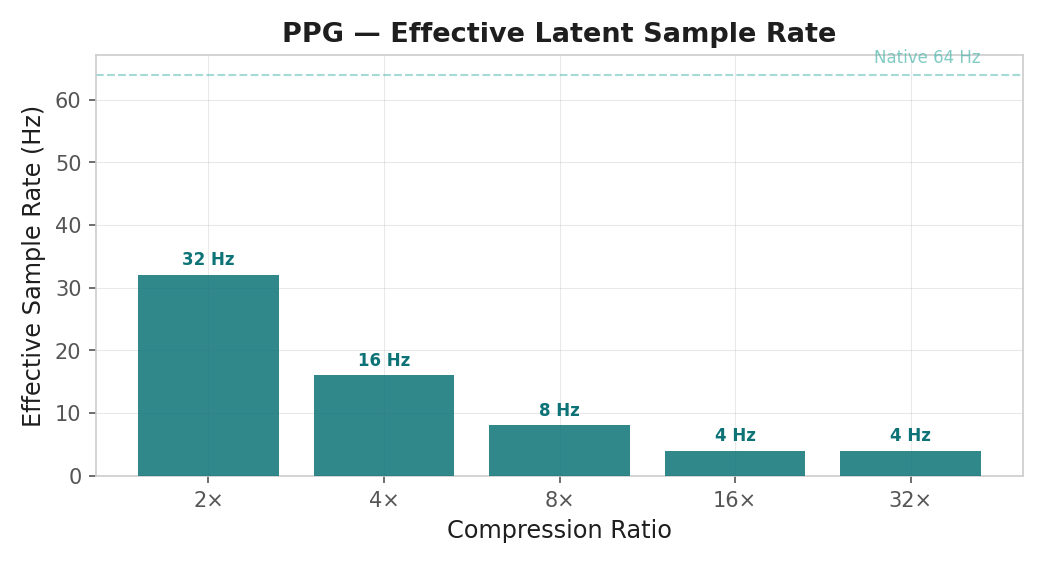
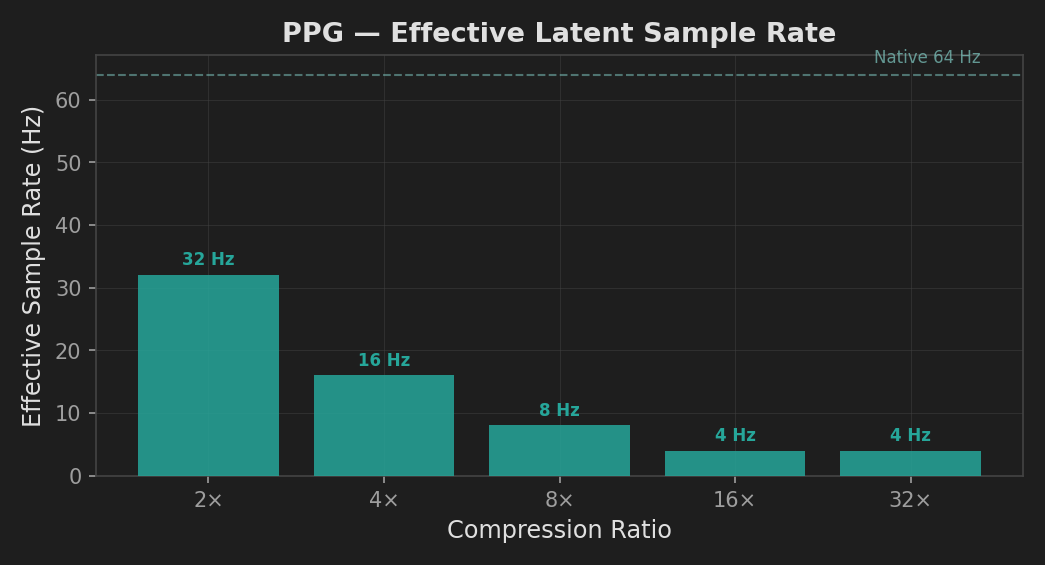
Section titled “Compression Ratio Breakdown”| Model | Encoder Stages | Downsample | Latent Positions | RVQ Levels | Bits/Frame |
|---|---|---|---|---|---|
| 02x | 1 | 2x | 160 | 2 | 2560 |
| 04x | 2 | 4x | 80 | 2 | 1280 |
| 08x | 3 | 8x | 40 | 2 | 640 |
| 16x | 4 | 16x | 20 | 2 | 320 |
| 32x | 4 | 16x | 20 | 1 | 160 |
| Model | CR |
|---|---|
| 02x | 2.00x |
| 04x | 4.00x |
| 08x | 8.00x |
| 16x | 16.00x |
| 32x | 32.00x |
Frame size = 320 samples (5 s at 64 Hz). Raw frame = 5120 bits (16-bit). Codebook size K = 256 (8 bits/index).
Latent sample rate plots
Loss Function
Section titled “Loss Function”- Primary: MSE
- Auxiliary: Derivative loss (weight 0.1) — preserves waveform first-derivative (morphology)
HR/HRV Preservation
Section titled “HR/HRV Preservation”Long-recording evaluation uses overlap-add reconstruction on 60 s continuous segments, then computes physiological metrics with physioKit:
Heart-rate error plots
SDNN error plots
RMSSD error plots
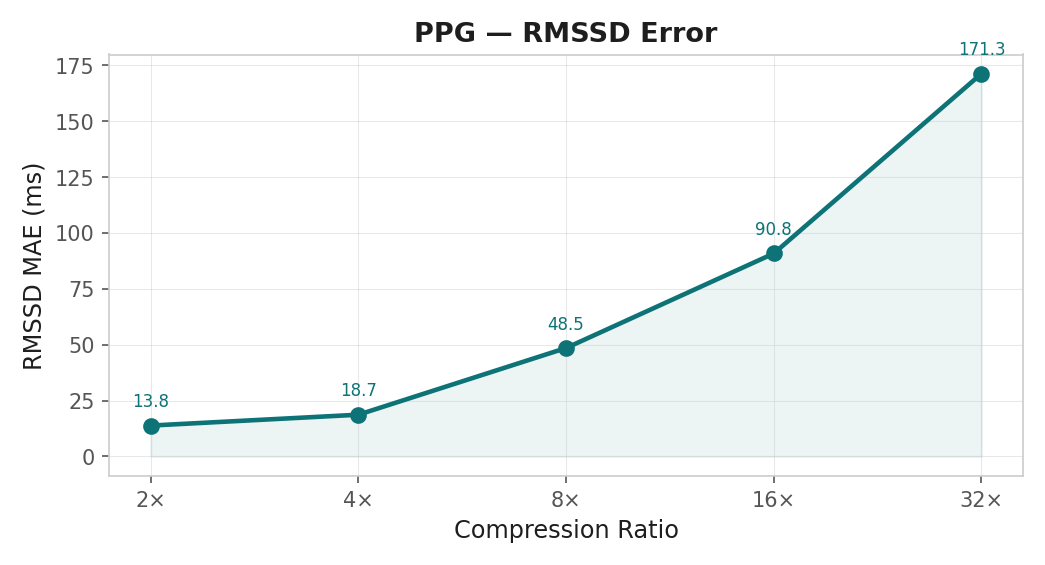
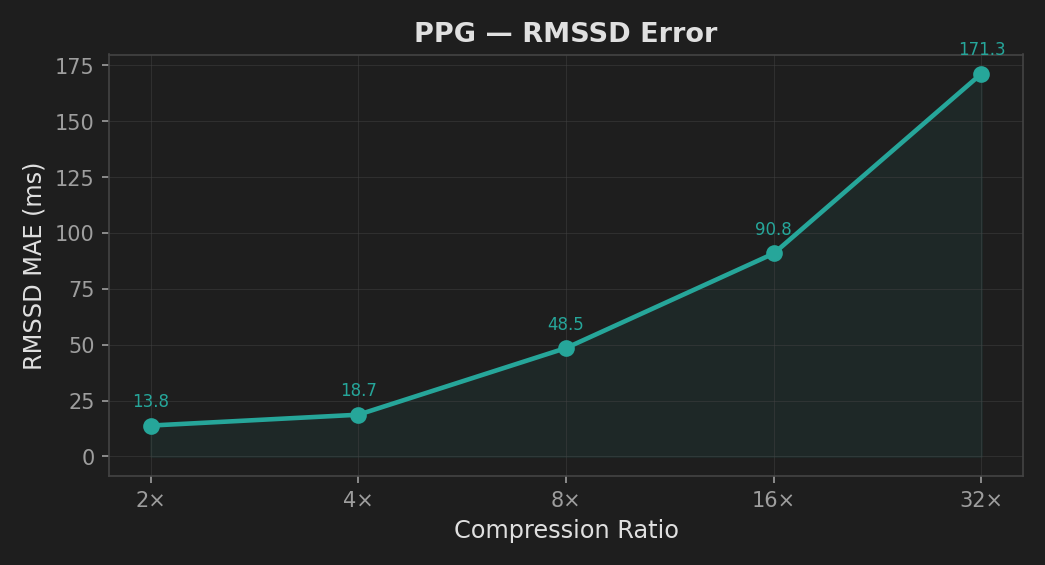
| Model | HR MAE (bpm) | HR Median AE | HR Bias | SDNN MAE (ms) | RMSSD MAE (ms) |
|---|---|---|---|---|---|
| 02x | 0.06 | 0.000 | +0.046 | 9.6 | 13.8 |
| 04x | 0.05 | 0.000 | +0.021 | 12.9 | 18.7 |
| 08x | 0.10 | 0.018 | +0.041 | 32.4 | 48.5 |
| 16x | 0.19 | 0.032 | +0.016 | 58.2 | 90.8 |
| 32x | 0.36 | 0.076 | +0.180 | 110.2 | 171.3 |
Dataset: Open unified PPG v1
Section titled “Dataset: Open unified PPG v1”The published v1 PPG goldens use ppg-unified-strict-sanitize-v1: a unified
mixture of BIDMC, BUT PPG, PPG-DaLiA, and WESAD. The release-facing PPG goldens
are MESA-free so users can reproduce the published artifacts without restricted
NSRR data.
MESA remains a supported restricted source for internal or custom experiments, but it is not used in the published v1 PPG goldens. See Dataset Setup for source-specific licensing and cache-building commands.
Build the cache
Section titled “Build the cache”# Build the open sources used by the v1 PPG goldens.uv run python scripts/build_ppg_cache.py \ --sources bidmc butppg ppg_dalia wesadTraining
Section titled “Training”# Reproduce a specific published operating point.uv run compressionkit golden run ppg-rvq-8x
# Reproduce all PPG RVQ goldens.uv run compressionkit golden run-all --modality ppg --method rvqOutput Structure
Section titled “Output Structure”results/ppg_rvq_64hz_08x_golden/├── best_model.weights.h5 # Best checkpoint├── config.json # Frozen config├── summary.json # Training metrics├── long_recording_eval.json # HR/HRV preservation metrics├── training_history_*.csv # Epoch-by-epoch metrics├── tensorboard/ # TensorBoard logs├── plots/ # Reconstruction plots└── deploy/ # Deployment artifacts ├── encoder.tflite # INT8 quantized encoder ├── encoder.h # C header for encoder ├── encoder.keras # Keras encoder model ├── decoder.keras # Keras decoder model ├── decoder_float32.tflite # Float32 LiteRT decoder for host-side decode ├── decoder.tflite # Optional INT8 decoder for on-device decode ├── decoder.h # Optional C header for INT8 decoder ├── codebook.npz # RVQ codebook weights ├── codebook.h # C header for codebook ├── sample_data.npz # 50 validation samples ├── model_card.json # Metadata used for publishing └── deploy_manifest.json # Artifact manifestDeployment
Section titled “Deployment”For the full runtime guide, see Deployment Guide.
Runtime Profile
Section titled “Runtime Profile”- Frame shape:
(1, 1, 320, 1)float32 - Sample rate:
64 Hz - Default HuggingFace repo pattern:
Ambiq/compressionkit-ppg-{cr}x-v1.1
Quickstart
Section titled “Quickstart”import numpy as np
from compressionkit.runtime import RVQCodec
t = np.arange(320, dtype=np.float32) / 64.0signal = (0.6 * np.sin(2.0 * np.pi * 1.2 * t) + 0.1 * np.sin(2.0 * np.pi * 2.4 * t)).reshape(1, 1, 320, 1)
codec = RVQCodec.from_pretrained("Ambiq/compressionkit-ppg-4x-v1.1")indices = codec.encode(signal.astype(np.float32))reconstruction = codec.decode(indices)Deployment Notes
Section titled “Deployment Notes”- Use
encoder.tflitepluscodebook.hfor the lowest-footprint embedded path. - Use
decoder_float32.tflitewhen reconstruction runs on a host or cloud service. - Add the two-stage prior only when bitrate is more constrained than compute or memory.
Extending
Section titled “Extending”To create a new PPG model variant:
- Copy an existing golden config:
cp configs/ppg_rvq_64hz_08x_golden.yaml configs/ppg_rvq_64hz_08x_v2.yaml - Modify parameters (e.g.
base_filters,num_levels,learning_rate) - Train:
uv run train-ppg-rvq --config configs/ppg_rvq_64hz_08x_v2.yaml - Compare results against the golden baseline